What Is a Good PI Cognitive Assessment Score?
· 5 min read
Key takeaways
- The average PI Cognitive Assessment score is 20 out of 50.
- A competitive score is 28 or higher. A score of 37 or higher is in the top 5%.
- Employers set a target score range for each role. You need to clear the range, not get a perfect score.
- A free 15-question sample test shows your level compared to other candidates.
The short answer
The average score on the PI Cognitive Assessment is about 20 out of 50. A score of 28 or higher is competitive - roughly the top quarter of candidates. A score of 37 or higher is exceptional, putting you in about the top 5%.
If you scored 20 and felt like you barely got through half the test, that is normal. That is what average looks like on this test. The time limit, not the difficulty of individual questions, is what keeps scores low.
How the benchmarks break down
Scores cluster around the average of 20, and thin out fast in both directions. Here is the practical read on each level:
| Score (out of 50) | Level | What it means |
|---|---|---|
| 0 - 15 | Below average | Usually a pacing problem, not an ability problem - and pacing is very trainable |
| 16 - 22 | Average | Where most candidates land; fine for many roles, but not a differentiator |
| 23 - 28 | Good | Above most candidates, and close to competitive with focused practice |
| 29 - 35 | Competitive | Clears the target range for the large majority of roles |
| 36 - 50 | Exceptional | Top 5% of candidates; very few score here |
And the percentile view of the same distribution:
| PI Cognitive Assessment score | Percentile |
|---|---|
| 11 | 10th |
| 16 | 25th |
| 20 | 50th (the average) |
| 27 | 75th |
| 33 | 90th |
| 37 | 95th |
What employers actually look for
Employers do not see your raw score the way you might expect, and most do not demand a perfect one. The Predictive Index lets companies set a target score range per role, based on the cognitive demands of the job. A data analyst role might have a higher target than a retail management role.
That has a practical consequence: you do not need to ace the test. You need to clear the target range for your role. For most jobs, that means the difference between 20 and 28 matters a lot, while the difference between 40 and 45 matters very little. We covered the scoring mechanics in more detail in how the PI Cognitive Assessment is scored.
Find out where you stand - for free
Reading benchmarks is one thing. Knowing your own number is another, and most people find theirs out on test day, when it counts.
You can find out now instead. The free sample test is 15 questions in 3.5 minutes - the same pace and the same three categories as the real test - and your results are plotted directly against the population baseline. You see your level, your percentile, and your weakest category.
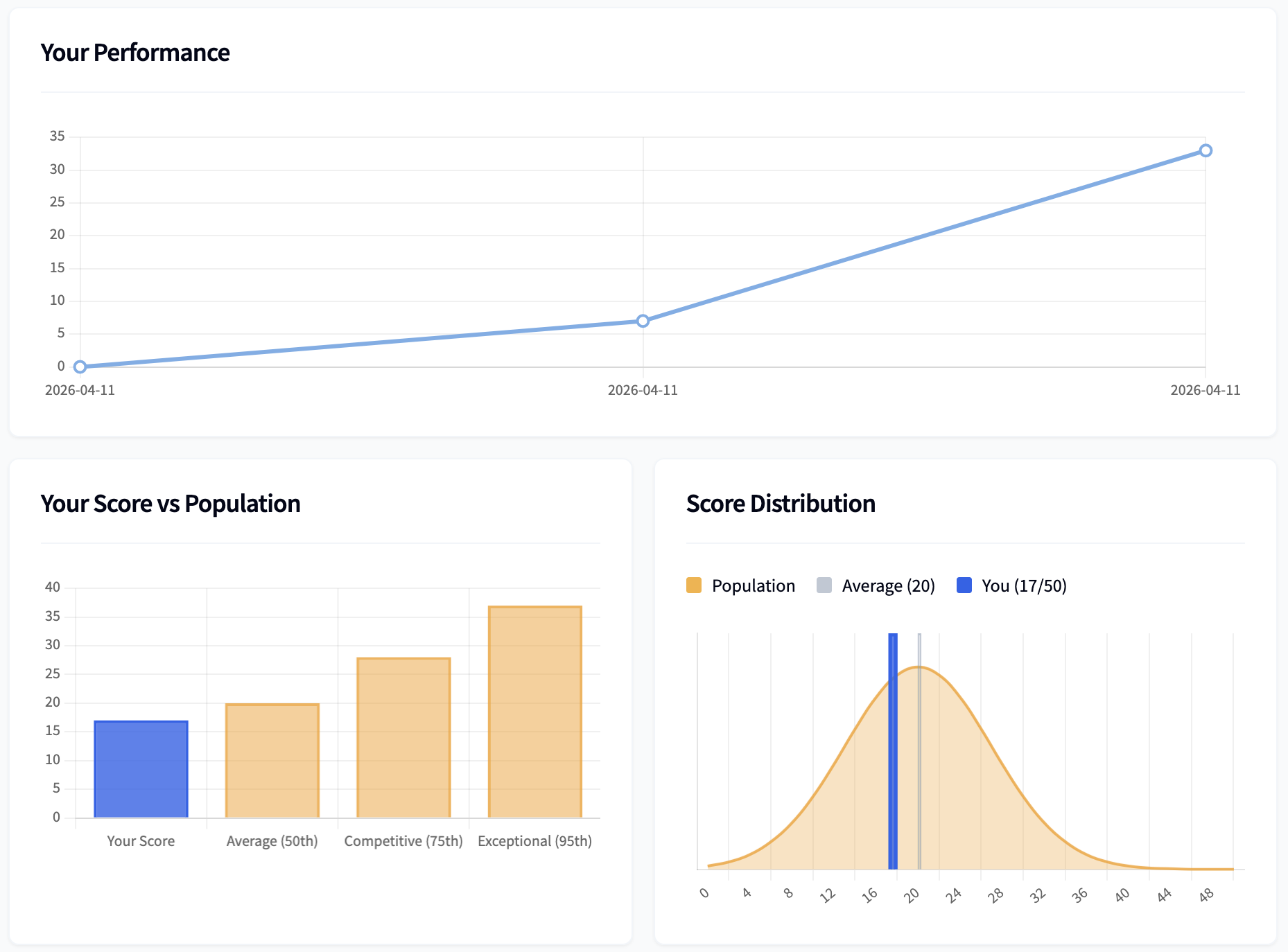
No payment, no commitment: create a free account and take it. If you want a taste without signing up at all, there is a 3-question mini sample right on this site.
Can you move your score?
Yes. Cognitive test scores respond to preparation - not because practice makes you smarter, but because familiarity removes the two biggest score killers: wasted time figuring out question formats, and poor pacing. Most people improve 10-20% with structured practice, which is exactly the gap between average and competitive.
If your sample result lands below where you need to be, that is not a verdict. It is a starting line, and it comes with a map: your weakest category is the highest-leverage place to start. The 7-day prep plan is a good structure for the week before your test.
Ready to practice?
500+ questions. Real test conditions. Instant scoring.